
Air Duct Cleaning: Repair or Replace? How Renton Homeowners Decide
If a duct cleaning company finishes a job and your energy bills don’t drop at all, the system likely has duct leakage that was never addressed. Cleaning removes what has settled inside the ducts; it does nothing for air that escapes into a crawlspace or attic before it reaches your rooms. In our experience around Renton, most homeowners book cleaning when the real problem is structural, then wonder why the house still feels drafty. Here’s how to tell which problem you actually have, and which one to pay for first.
Key Takeaways
- Cleaning fixes contamination. Sealing fixes leakage. They’re different problems with different symptoms.
- Dust that returns within weeks points to leakage, not dirty ducts.
- Damaged flex duct in a vented crawlspace is common in Renton’s older housing stock, and it’s often repairable.
- Sequence matters: sometimes you clean first for access, sometimes you seal first so the freshly cleaned system stays clean.
How do you tell duct leakage from duct contamination?
Duct contamination shows up as dust, debris, and odors. Duct leakage shows up as air going somewhere it shouldn’t. They overlap often enough that homeowners assume one is the other, so start with the signs rather than the sales pitch.
Contamination signs you’ll notice inside the living space:
- Visible dust puffing from supply registers when the system starts
- Musty or stale smell that gets stronger when the HVAC runs
- Dust settling on surfaces within days of cleaning a room
- Debris visible at the register boot when you remove the grille
Leakage signs that point to a structural problem:
- Rooms that never heat or cool evenly, regardless of thermostat setting
- High bills without a matching comfort result
- Dust returning fast after a professional cleaning
- Whistling or rushing sounds at joints, especially in crawlspaces and attics
- Condensation or moisture staining near duct runs in unconditioned space
If two or more leakage signs are present, cleaning alone won’t fix your comfort problem. It might be part of the answer, but sealing is the piece that closes the gap. If you’d rather not crawl around the attic guessing, call us at (888) 423-4218 and we’ll take a look.
Which comes first: cleaning or repair?
It depends on access and on how bad the leakage is. Cleaning first makes sense when debris blocks the ducts enough that a technician can’t properly inspect or reach the damaged section. Sealing first makes sense when leakage is severe enough that cleaning a leaking system just re-contaminates it from the crawlspace or attic side.
Two common sequences we work through in Renton homes:
- Clean, then inspect, then repair. Best when the ducts are heavily loaded with debris and the leakage is moderate. Cleaning clears the view so the camera can find the actual failures.
- Inspect, then repair, then clean. Best when there’s obvious disconnected or torn ductwork in a vented crawlspace or attic. Sealing first prevents the freshly cleaned system from pulling outside air back in.
There’s a third case worth naming: ducts that need both at once. When a technician finds a torn flex run mid-clean, the practical move is to repair on the same visit so the system doesn’t sit half-finished for a week. That’s why we treat air duct cleaning and duct repair as one visit rather than two separate contractors.
The wrong sequence costs money. Cleaning a badly leaking system and stopping there is the most common version: the homeowner pays for a clean, the leakage pulls dust back into the ducts within weeks, and the bill feels wasted. If your ducts show leakage signs, get an inspection before you book the cleaning.
Flex duct or sheet metal: what decides repair vs. replacement in Renton?
Flex duct is repairable when the damage is localized: a tear near a fitting, a sagging run, a disconnected collar. It needs full replacement when it’s crushed, collapsed, or contaminated with moisture and microbial growth that cleaning can’t reach. Age tips the decision too. Flex duct that’s been in a vented crawlspace long enough to sag, kink, and collect moisture typically isn’t worth patching run by run.
Sheet metal is a different calculation. Dented or separated sections can usually be resealed and rejoined. Rusted-through sections near a crawlspace or attic get cut out and replaced. Sheet metal rarely needs to be removed wholesale unless it’s been soaked and left to sit.
What tips the scale in Renton:
- Crawlspace conditions. Vented crawlspaces in older Renton homes stay damp through winter, which stresses flex duct faster than a conditioned attic would.
- Number of failures. One torn run is a repair. Four failing runs in the same trunk are usually a replacement.
- Access. Ductwork buried under insulation or jammed between joists makes patching slower and less reliable than pulling and replacing the run.
- Material quality. Builder-grade flex doesn’t tolerate kinks or compression well; the same damage that’s a quick patch on quality flex becomes a replacement on a stretched-out run.
We work with Honeywell and Aprilaire components in homes that already run filtration or humidification gear, so a repair plan fits what’s installed rather than fighting it.
What does a camera inspection actually show?
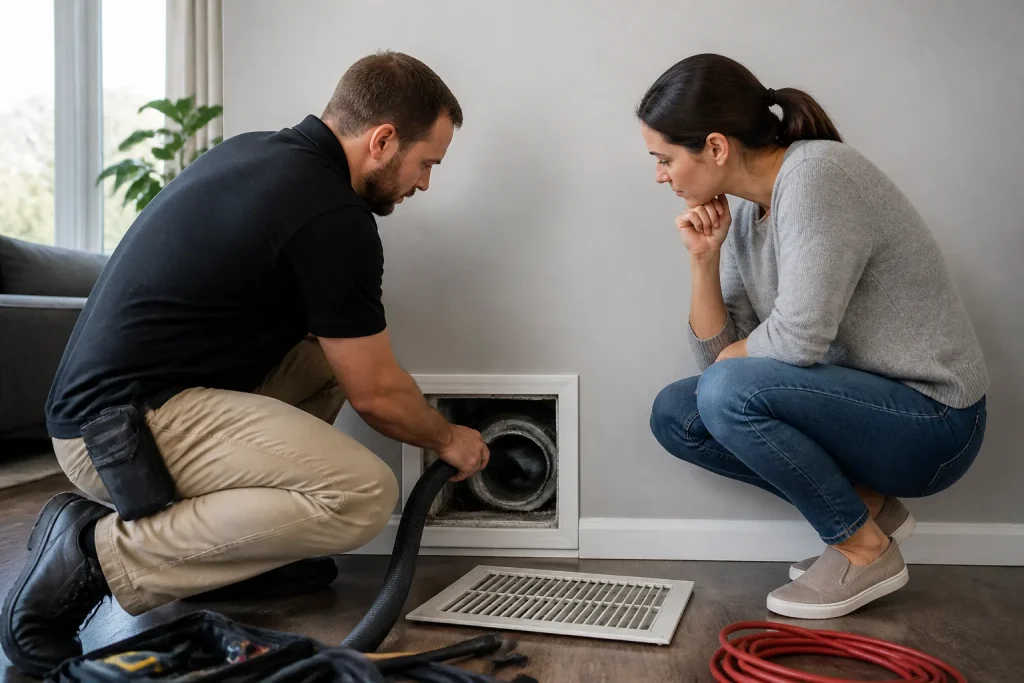
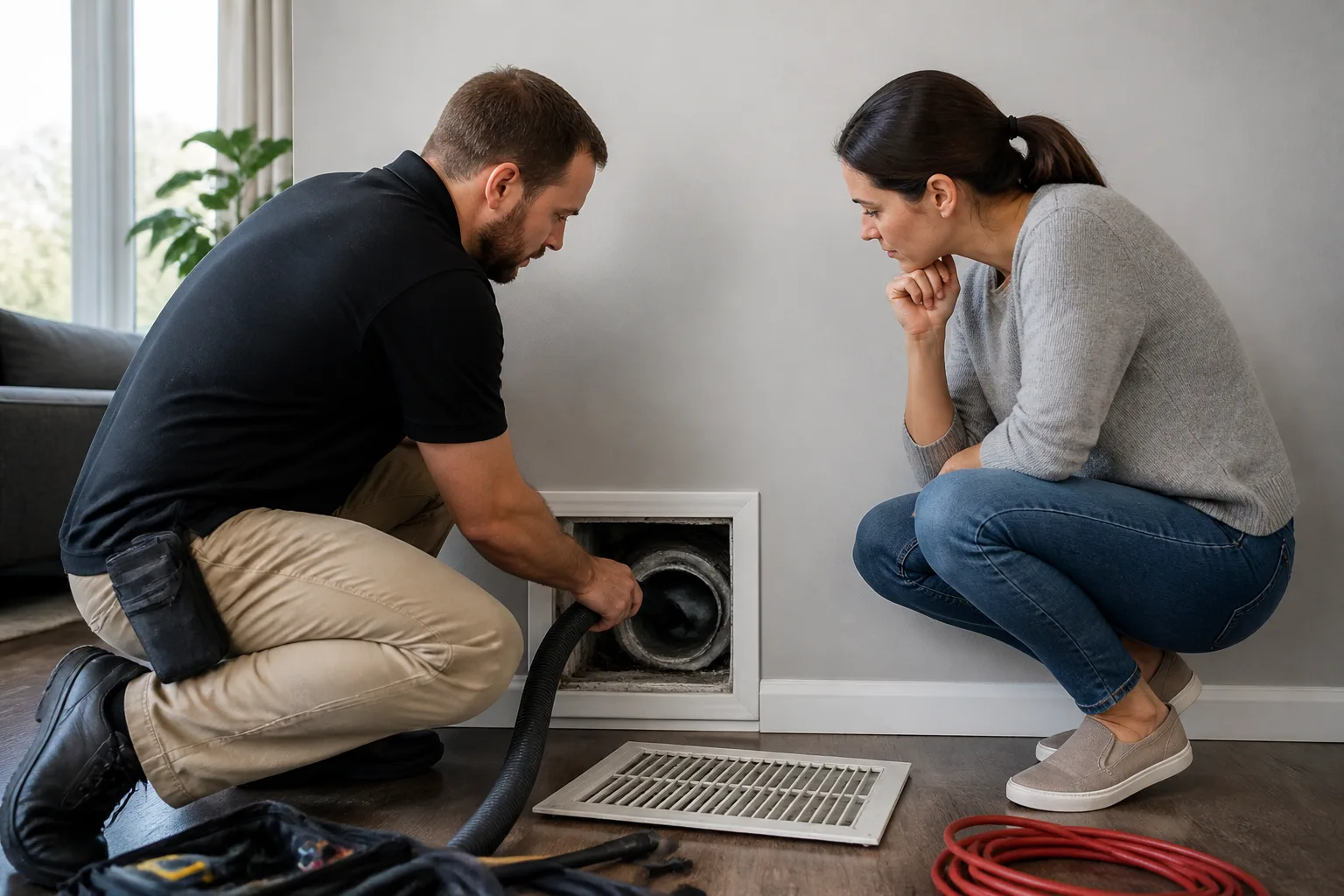
A camera inspection shows the inside of the duct system as it actually is, not as the technician hopes it is. That matters because it separates opinion from evidence. “Your ducts are dirty” is an opinion until you see the debris. “There’s a disconnected flex collar at this joint” is something you can look at.
With Rotobrush systems, the camera run threads through the supply and return trunks and records what’s there. What a proper inspection reveals:
- Debris accumulation levels in each trunk and branch
- Seams, joints, and collars that have opened up
- Tears, kinks, and compression points in flex runs
- Moisture staining or microbial growth
- Whether the HVAC cabinet and coil are contributing to the problem
That footage is the difference between a repair recommendation and a sales pitch. If a technician quotes a repair without showing you the footage, ask for it. Any honest shop will pull it up. We use the same footage to decide whether HVAC cleaning belongs in the same visit, because the air handler is part of the pathway whether the ducts are clean or not.
During the actual cleaning, we run Abatement Technologies equipment to hold negative pressure inside the system. That keeps loosened debris contained instead of settling back into the house, which matters when the ducts are getting cleaned while a repair is also underway.
Does sealing actually pay for itself in Renton?
Sealing leaky ducts pays back when the leakage is significant and the ducts run through unconditioned space. In a Renton home, that usually means ductwork in a vented crawlspace or attic. Air escaping there is air you paid to heat or cool, and it’s doing nothing for the room above it.
The payback math is straightforward, even if the numbers aren’t universal:
- Find the leakage percentage during inspection. Unsealed duct systems leak a lot; the exact share varies by house, so measure it rather than guess.
- Estimate the heating and cooling cost share that’s being lost. If duct leakage runs through unconditioned space, most of that lost air never reaches your rooms.
- Compare that loss against your Puget Sound Energy bill, month by month.
- Divide the sealing cost by the monthly loss to get a rough payback period. Most sealing jobs that fix real leakage fall inside a few heating seasons, though a badly leaking older system can pay back faster.
The reason sealing belongs in the same conversation as cleaning is that they’re solving the same underlying problem: air reaching rooms in the condition you intended. Cleaning fixes what’s in the air. Sealing fixes where the air goes. Doing one without the other leaves a gap you’ll notice on the next energy bill. Our technicians have up to 12 years of experience reading that difference in the field, and the inspection footage is what they’ll walk you through.
When should you call a pro instead of handling it yourself?
Call a pro when you can’t see the ducts, when the system has been wet, or when the diagnosis isn’t obvious. Ductwork in a crawlspace or attic involves confined-space hazards, sharp edges, and possible electrical contacts, and a torn flex joint you can’t reach is a job for someone with the right gear.
Reasons to bring in a technician:
- Duct runs you can’t reach or safely inspect
- Any sign of moisture, staining, or growth inside the ducts
- Diagnosis isn’t clear: cleaning and sealing could both be plausible, but you don’t know which
- Repair work that involves reconnecting collars or replacing runs in tight attic or crawlspace locations
- Sanitizing after a moisture event, where Guardsman-grade protection products are part of the treatment
That first one is the level-headed reason we exist. Renton Air Duct Cleaning Pros is built around the full air pathway: supply and return ducts, the HVAC unit, dryer vent cleaning, and duct repair under one roof. When a job needs two of those, we handle the second on the same visit rather than handing you off.
If you want to see for yourself what’s inside your system before deciding, an inspection is free with a written estimate. If the ducts turn out fine, we’ll say so.
The Bottom Line
Cleaning and sealing solve different problems, and in Renton, most homes that feel drafty or dusty need both in the right order. The sequence isn’t a sales tactic: sealing a leaking system before cleaning keeps it clean, and cleaning a badly clogged system before sealing lets a technician actually see the failures and fix them.
Repair vs. replace comes down to severity and access. One damaged flex run is a patch. Crushed, wet, or multiple failing runs in the same crawlspace usually justify replacement. And any repair recommendation should come with camera evidence, not a pitch.
If you’re in Renton and need help, Renton Air Duct Cleaning Pros offers free estimates. Call (888) 423-4218. We answer 24/7. Fast dispatch from 7am to 7pm, Sunday through Friday.
Frequently Asked Questions
Every job gets one flat estimated price per system, agreed before work starts, based on the number of trunks, runs, and any repair or sealing work the inspection turns up. Call (888) 423-4218 for a free estimate.
Usually yes. A localized tear near a fitting, collar, or bend can typically be patched or reconnected, provided the duct isn’t crushed or water-damaged. Multiple failing runs in the same crawlspace usually make full replacement the better call. Call (888) 423-4218 and we’ll inspect the run and tell you which applies.
You get before-and-after photos plus camera footage of the ducts before and after the cleaning, and the same evidence for any sealing or repair work. If a technician can’t show you the footage, you don’t have proof. Call (888) 423-4218 to schedule an inspection.
It depends on how much debris and leakage are present. Heavily loaded ducts usually need cleaning first so the technician can inspect. Badly leaking ducts in a vented crawlspace usually need sealing first so the cleaned system stays clean. The camera inspection decides. Call (888) 423-4218 for an estimate.
Written by the team at Renton Air Duct Cleaning Pros.
Need Air Duct Cleaning Help?
Call Renton Air Duct Cleaning Pros - the local pro we connect you with is licensed and insured, here with fast help in Renton.
(888) 423-4218